

Yoga for Addiction & Mental Health Recovery: How Movement Heals the Mind and Body
Recovery is not a single event. It is a gradual rebuilding of the whole person: body, mind, and spirit. At Crow's Nest Ranch Sober Living and Outpatient in Truckee-Tahoe, California, we have seen firsthand how yoga for addiction recovery helps clients develop the tools they need to stay sober, manage difficult emotions, and build a life they genuinely want to live.
Yoga has moved well beyond the fitness studio. Over the past two decades, a growing body of peer-reviewed research has established it as a clinically meaningful complement to conventional substance abuse treatment. This article explains what that science says, why yoga works as part of a holistic treatment plan, and what you can expect from our program.
What the Research Says About Yoga in Substance Abuse Treatment
Skepticism about complementary therapies in addiction medicine is healthy. That is why it matters that yoga's role in substance use disorder treatment is now backed by credible, published evidence, not just anecdote.
A 2014 systematic review published in the Journal of Psychiatric Practice examined yoga-based interventions across multiple substance use populations and found consistent evidence that yoga reduced cravings, improved mood, and lowered stress levels in participants. The authors noted particular promise for individuals with co-occurring anxiety and depression, which represent the majority of people seeking addiction treatment.
The National Institute on Drug Abuse (NIDA) recognizes mind-body practices as part of an integrative care model, noting that approaches targeting the relationship between physical states and emotional regulation address neurological patterns that substance use disorders share with other chronic conditions. NIDA's research on stress and relapse consistently identifies the dysregulation of the hypothalamic-pituitary-adrenal (HPA) axis as a key driver of craving and relapse, and yoga has been shown to reduce cortisol levels and restore balance to that system.
A randomized controlled trial published in Drug and Alcohol Dependence (Zhuang et al., 2013) found that participants in a yoga intervention group showed significantly greater reductions in depression scores and stress reactivity compared to a control group receiving standard treatment alone. For a population where depression and anxiety are among the most common relapse triggers, this is a meaningful clinical outcome.
The Substance Abuse and Mental Health Services Administration (SAMHSA) has included yoga and mindfulness-based practices in its guidelines for treating co-occurring disorders, citing evidence for improvements in emotional regulation, sleep quality, and treatment retention among adults with substance use disorders.
Yoga and Dual Diagnosis: Why Mental Health Recovery Matters
The majority of people who struggle with addiction also live with at least one co-occurring mental health condition. According to SAMHSA's National Survey on Drug Use and Health, approximately 9.5 million adults in the United States had both a substance use disorder and a mental illness in a recent reporting year. At Crow's Nest Ranch, we treat the whole picture, and yoga plays a direct role in addressing both sides of a dual diagnosis.
How Yoga Affects the Brain and Nervous System
Addiction reshapes the brain's reward circuitry, dampening the prefrontal cortex's ability to regulate impulse and emotion while amplifying the amygdala's stress response. This neurological imbalance is one reason why early recovery can feel so raw and overwhelming.
Yoga works on precisely these systems. Research published in Frontiers in Human Neuroscience (Gothe and McAuley, 2015) found that regular yoga practice was associated with increased gray matter density in the prefrontal cortex and reduced volume of the amygdala, the brain's fear and stress center. These structural changes support better emotional regulation, lower baseline anxiety, and improved decision-making, all of which are critical for sustained recovery.
Yoga also activates the parasympathetic nervous system through slow, controlled breathing (pranayama) and deliberate physical movement. This counters the chronic "fight or flight" activation that characterizes both active addiction and early withdrawal. When the nervous system learns to find rest through the breath and the body, clients gain a self-regulation tool they can use anywhere, at any time, without medication.
Reducing Cravings and Managing Triggers
A study published in the Journal of Substance Abuse Treatment (Zhuang et al., 2013) found that yoga participants reported significantly fewer cravings during the intervention period compared to control groups. The researchers attributed this in part to yoga's effect on GABA (gamma-aminobutyric acid) levels, a neurotransmitter that plays a role in anxiety regulation and is directly disrupted by alcohol and benzodiazepine use.
Earlier research by Streeter and colleagues, published in the Journal of Alternative and Complementary Medicine (2007), used magnetic resonance spectroscopy to show that a single session of yoga increased thalamic GABA levels by 27 percent compared to walking. For individuals whose substance use was partly driven by anxiety or the need to quiet an overactive nervous system, this is a significant finding: yoga offers a neurochemical pathway to calm that does not require a substance.
The Core Benefits of Yoga for Recovery
Stress Reduction and Emotional Regulation
Recovery exposes people to the full weight of their emotions, often for the first time in years. Without a substance to blunt the experience, stress, grief, shame, and fear can feel overwhelming. Yoga provides a structured, body-based method for tolerating and processing those states rather than avoiding them.
The mindfulness component of yoga, the practice of observing experience without immediately reacting to it, closely mirrors the core principles of Dialectical Behavior Therapy (DBT) and Acceptance and Commitment Therapy (ACT), two evidence-based modalities we use extensively at Crow's Nest Ranch. When clients practice yoga alongside these therapies, the skills reinforce each other.
Rebuilding the Mind-Body Connection
Addiction often creates a profound disconnection from the physical self. Clients describe feeling numb, checked out, or trapped in a body they do not recognize. Substance use disorders are associated with high rates of trauma, and trauma research consistently shows that healing requires working through the body, not only through talk therapy. Dr. Bessel van der Kolk, whose research on trauma and somatic treatment has been widely published including in his cited work in Journal of Traumatic Stress, has described yoga as one of the most effective tools for helping trauma survivors regain a sense of ownership over their physical experience.
Yoga postures (asanas) require attention to physical sensation, breath, alignment, and balance. This gentle, sustained attention to the body helps rebuild the interoceptive awareness that addiction disrupts, and it does so in a way that feels safe and self-directed.
Structural Support for Recovery: Routine, Discipline, and Community
Long-term recovery depends in part on structure. The rituals of a regular yoga practice, showing up at a set time, moving through a consistent sequence, breathing with others in the room, mirror the kinds of healthy routines that support sobriety outside the clinic.
Group yoga also creates a sense of shared purpose. For many clients, addiction has eroded their sense of belonging and connection. Practicing in a group, breathing together, holding poses together, and meeting difficulty together builds a quiet but genuine sense of community that reinforces the relational dimensions of recovery.
Yoga as a Form of Gradual Exposure in Recovery
One aspect of yoga's power that is often underappreciated is its function as a low-stakes training ground for tolerating discomfort.
A difficult pose creates physical challenge. Holding it requires the practitioner to stay present, breathe through the sensation, and resist the urge to escape. Over time, this trains the same capacity for distress tolerance that clients need when they encounter cravings, interpersonal conflict, or the ordinary frustrations of life without a substance.
This is not a metaphor. It is grounded in the same neuroscience underlying exposure-based therapies used in cognitive behavioral treatment for anxiety and PTSD. The practitioner learns, at a physical and experiential level, that discomfort is survivable and that it passes. That learning carries into life outside the studio.
Physical Healing Alongside Emotional Recovery
Substance use takes a measurable toll on the body. Disrupted sleep, weakened immune function, poor cardiovascular fitness, and chronic muscle tension are common among individuals entering treatment.
Yoga addresses these physical dimensions directly. Research published in Alternative Therapies in Health and Medicine has documented yoga's positive effects on sleep quality, immune markers, and inflammatory biomarkers. Improved sleep alone is clinically significant: sleep disruption is one of the strongest predictors of relapse in the early months of recovery, and clients who sleep better are better equipped to manage stress, make clear decisions, and stay engaged in treatment.
For clients in our PHP, IOP, and OP programs, yoga also provides a constructive physical outlet that complements the more intensive training available through our HIIT, Muay Thai, and Jiu-Jitsu offerings. The combination of restorative and high-intensity movement gives the body a full range of healing stimulation.
Take The Next Steps To Optimize Yourself and Heal Through Holistic Treatment
Our program completion success rate is 95%.We accept most PPO insurance plans and Medi-Cal for Placer and Nevada County residents. Private pay options are available.If you or someone you love is ready to begin, we are here.
Recover Through Holistic Medicine at Crow's Nest Ranch
Our Yoga for Recovery program is part of a comprehensive, individualized treatment model built around the principle that lasting sobriety requires healing every dimension of the person.
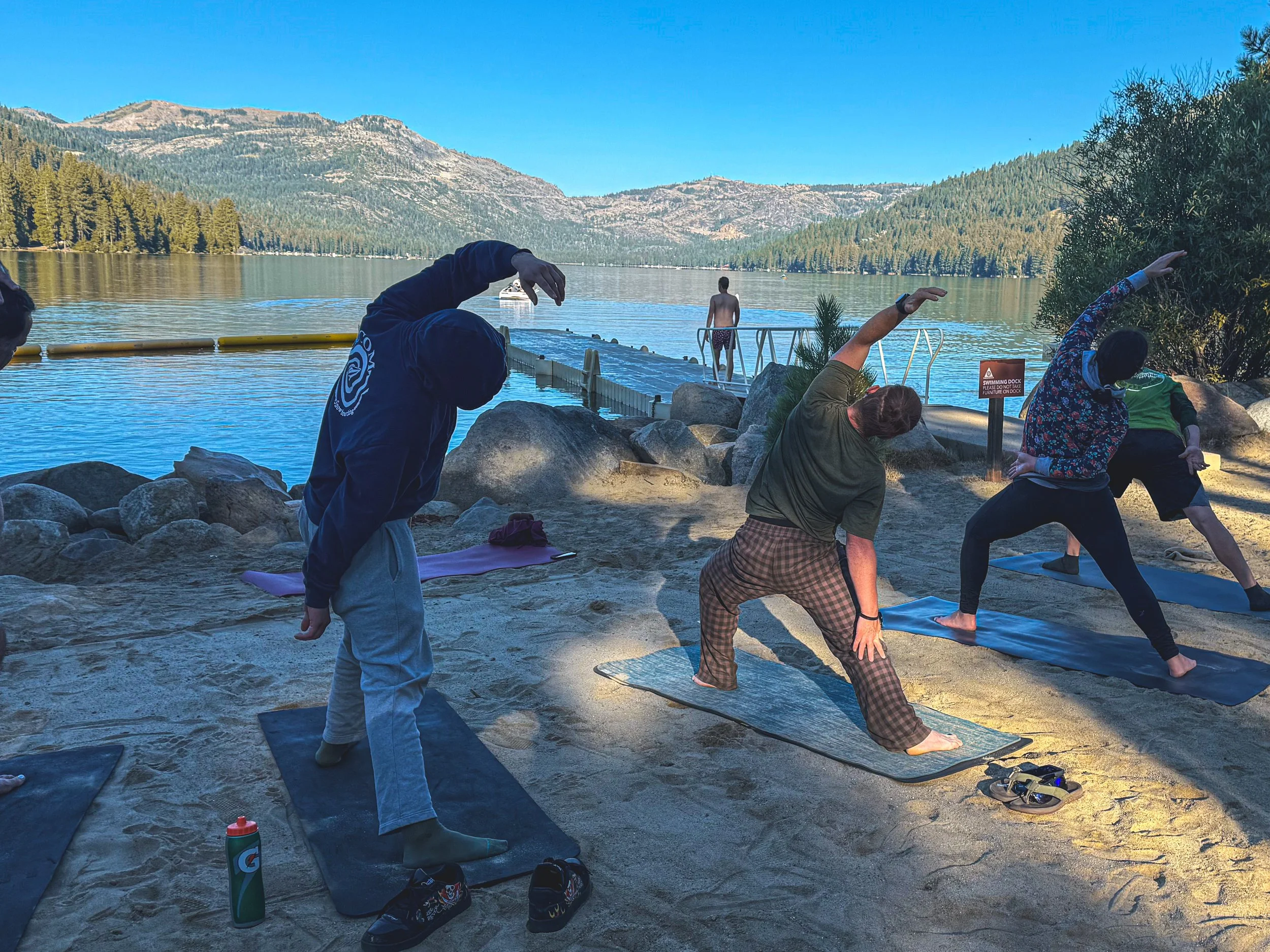
Located in the Truckee-Tahoe region of Northern California, our facility offers a natural setting that complements the calming, restorative goals of yoga practice. Surrounded by mountains, fresh air, and access to outdoor and adventure therapy, clients have the physical environment to support genuine healing alongside the clinical structure to make that healing stick.
Our yoga sessions are taught by skilled instructors who understand addiction and recovery. Sessions are adapted for all fitness levels and experience backgrounds, from first-timers stepping on a mat for the very first time to long-term practitioners returning to their practice.
Yoga at Crow's Nest Ranch does not exist in isolation. It is integrated with:
Evidence-based individual and group therapies: ACT, CBT, DBT, and EMDR
Neurofeedback for nervous system regulation
Somatic and movement-based modalities including Jiu-Jitsu, Muay Thai, and HIIT fitness
Outdoor and adventure therapy in the Sierra Nevada
Individualized aftercare planning for long-term recovery support
We accept most PPO insurance plans including Anthem Blue Cross, Blue Cross Blue Shield, Cigna, Magellan Healthcare, Optum, and UnitedHealthcare, as well as Medi-Cal for residents of Placer and Nevada County. Private pay and sliding-scale options are also available.
Our program has a 95% rate of completion, a number we are proud of because it reflects not just clinical structure but the genuine connection clients build with their treatment, their peers, and themselves during their time with us.
Sources Cited:
Cramer, H., Lauche, R., Langhorst, J., and Dobos, G. (2013). Yoga for depression: A systematic review and meta-analysis. Depression and Anxiety, 30(11), 1068-1083.
Goyal, M., Singh, S., Sibinga, E.M., Gould, N.F., Rowland-Hayek, A., Sharma, R., Berger, Z., Sleicher, D., Maron, D.D., Shihab, H.M., Ranasinghe, P.D., Linn, S., Saha, S., Bass, E.B., and Haythornthwaite, J.A. (2014). Meditation programs for psychological stress and well-being: A systematic review and meta-analysis. JAMA Internal Medicine, 174(3), 357-368.
Khalsa, S.B.S. (2004). Treatment of chronic insomnia with yoga: A preliminary study with sleep-wake diaries. Applied Psychophysiology and Biofeedback, 29(4), 269-278.
Khalsa, S.B.S., Khalsa, G.S., Khalsa, H.K., and Khalsa, M.K. (2008). Evaluation of a residential Kundalini yoga lifestyle pilot program for addiction in India. Journal of Ethnicity in Substance Abuse, 7(1), 67-79.
Khanna, S. and Greeson, J.M. (2013). A narrative review of yoga and mindfulness as complementary therapies for addiction. Complementary Therapies in Medicine, 21(3), 244-252.
Li, A.W. and Goldsmith, C.A. (2012). The effects of yoga on anxiety and stress. Alternative Therapies in Health and Medicine, 18(3), 34-43.
Pascoe, M.C. and Bhide, R. (2015). A systematic review of randomised control trials on the effects of yoga on stress measures and mood. Journal of Psychiatric Research, 68, 270-282.
SAMHSA. (2020). Key Substance Use and Mental Health Indicators in the United States: Results from the 2019 National Survey on Drug Use and Health. Substance Abuse and Mental Health Services Administration, Rockville, MD.
van der Kolk, B.A., Stone, L., West, J., Rhodes, A., Emerson, D., Suvak, M., and Spinazzola, J. (2014). Yoga as an adjunctive treatment for posttraumatic stress disorder: A randomized controlled trial. Journal of Clinical Psychiatry, 75(6), e559-e565.
Zhuang, S.M., An, S.H., and Zhao, Y. (2013). Yoga effects on mood and quality of life in Chinese women undergoing heroin detoxification: A randomized controlled trial. Nursing Research, 62(4), 260-268.
Zope, S.A. and Zope, R.A. (2013). Sudarshan Kriya yoga: Breathing for health. International Journal of Yoga, 6(1), 4-10.